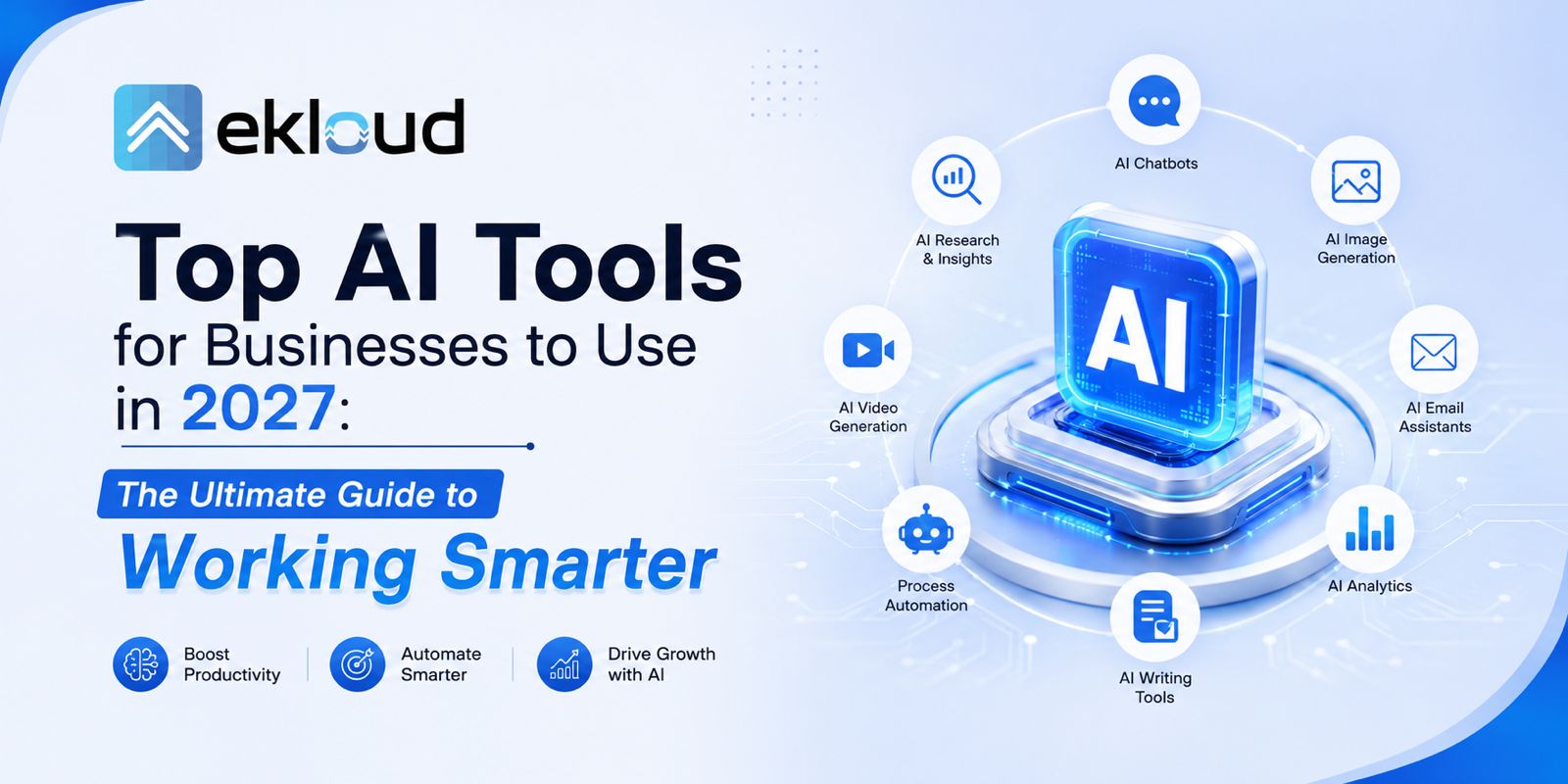
Top AI Tools for Businesses to Use in 2027: The Ultimate Guide to Working Smarter
Artificial Intelligence is no longer just a buzzword—it's becoming a part of everyday business. Whether you're replying to customer emails, analyzing sales data, writing marketing content or automating repetitive tasks, chances are AI can help you do it faster and more efficiently.
In fact, businesses are no longer asking, "Should we use AI?" Instead, they're asking, "Which AI tools should we invest in?"
The challenge isn't finding AI tools—it's choosing the ones that genuinely add value to your business.
In this guide, we'll explore the top AI tools businesses should use in 2027, what makes them stand out, and how they can help teams save time, improve productivity, and make smarter decisions.
Why AI Is Becoming Essential for Businesses
Businesses today operate in a fast-paced digital world where customers expect quick responses, personalized experiences, and seamless services. Simultaneously, teams are expected to do more with fewer resources.
This is where AI makes a difference.
Instead of replacing people, AI takes care of repetitive and time-consuming tasks, allowing employees to focus on creativity, problem-solving, and strategy.
Organizations are using AI to:
- Automate daily workflows.
- Generate reports in seconds.
- Create high-quality content.
- Improve customer support.
- Analyze business data faster.
- Increase sales productivity.
- Enhance employee collaboration.
- Reduce operational costs.
The businesses embracing AI today are building a strong foundation for future growth.
1. ChatGPT – Your Everyday AI Business Assistant
If there's one AI tool that has transformed workplaces across industries, it's ChatGPT.
Think of it as a digital assistant that can help with writing emails, drafting blogs, brainstorming ideas, summarizing documents, creating presentations, generating code, and answering business questions in seconds.
Marketing teams use it for content creation, HR teams prepare job descriptions, developers solve coding challenges, and executives quickly summarize lengthy reports.
Best for:
- Content creation.
- Business communication.
- Research.
- Brainstorming.
- Customer support.
- Documentation.
Why Businesses Love It
✔ Saves hours every week
✔ Easy to use
✔ Works across departments
✔ Improves productivity without a steep learning curve
2. Microsoft Copilot – AI Built Into Your Daily Work
If your organization relies on Microsoft 365, Copilot can significantly improve everyday productivity.
Instead of manually creating reports or searching through long email threads, employees can simply ask Copilot to summarize meetings, draft proposals, analyze Excel data, or create PowerPoint presentations.
It's like having an AI assistant built directly into the tools your team already uses.
Best for :
- Microsoft Word.
- Excel.
- Outlook.
- Teams.
- PowerPoint.
Business Benefits :
- Faster reporting.
- Smarter data analysis.
- Better collaboration.
- Reduced administrative work.
3. Google Gemini – Smarter Collaboration for Google Workspace
Businesses using Google Workspace can benefit from Gemini's AI-powered capabilities.
Whether it's writing emails in Gmail, generating documents, building presentations, or organizing meeting notes, Gemini helps teams work more efficiently without constantly switching between applications.
It's especially valuable for distributed teams collaborating across different locations.
4. Salesforce Agentforce – AI That Strengthens Customer Relationships
Customer expectations continue to rise, and businesses need faster, more personalized service than ever before.
Salesforce Agentforce helps organizations automate customer interactions, qualify leads, assist support teams, and streamline sales processes using intelligent AI agents.
Instead of replacing customer service representatives, it helps them resolve issues more efficiently while delivering a better customer experience.
Perfect For :
- Sales teams.
- Customer support.
- CRM automation.
- Service operations.
5. Tableau AI – Turning Data Into Actionable Insights
Many organizations collect massive amounts of data—but struggle to use it effectively.
Tableau AI simplifies data analysis by allowing users to ask questions in natural language and instantly receive visual insights.
Rather than spending hours building reports, business leaders can quickly understand trends, identify opportunities, and make informed decisions.
It's a game-changer for companies that want to become more data-driven.
6. GitHub Copilot – A Productivity Booster for Developers
Software development is becoming increasingly AI-assisted.
GitHub Copilot helps developers write code faster by suggesting functions, completing code snippets, and reducing repetitive programming tasks.
Rather than replacing developers, it acts like an experienced coding partner, allowing teams to focus on solving complex problems instead of writing boilerplate code.
7. Notion AI – Smarter Knowledge Management
Every business has valuable information scattered across documents, meeting notes, emails, and project files.
Notion AI helps organize this information into a searchable knowledge base while also assisting with writing, summarizing, brainstorming, and project planning.
For growing teams, this means less time searching for information and more time getting work done.
8. Canva AI – Design Without the Complexity
Creating professional-looking marketing content no longer requires advanced design skills.
Canva AI helps businesses generate presentations, social media graphics, videos, and promotional materials within minutes.
Whether you're a startup founder or part of a marketing team, Canva AI makes visual content creation faster and more accessible.
9. Zapier AI – Automating Repetitive Business Processes
Imagine automatically sending customer inquiries to the right team, updating your CRM after every sale, or generating reports without lifting a finger.
That's exactly what Zapier AI helps businesses achieve.
By connecting hundreds of business applications, it automates repetitive workflows and eliminates manual tasks, saving both time and effort.
10. Microsoft Power BI with AI – Smarter Business Intelligence
Business decisions are only as good as the data behind them.
Power BI combines powerful dashboards with AI capabilities to help organizations visualize trends, forecast future performance, and uncover valuable insights.
Executives can monitor KPIs in real time, while managers gain a clearer understanding of business performance without relying on manual reporting.
How to Choose the Right AI Tool for Your Business ?
With hundreds of AI platforms available, it's easy to feel overwhelmed.
Instead of chasing every new tool, start by asking:
- What business problem are we trying to solve?
- Will this tool integrate with our existing systems?
- Is our data secure?
- Can our emplo
- easily adopt it?Will it save time or reduce costs?
- Does it offer measurable ROI?
The best AI solution isn't necessarily the most advanced—it's the one that fits your business goals.
Tips for Successfully Adopting AI
Introducing AI into your business doesn't have to be complicated.
Here are a few practical tips:
- Start with one department before expanding company-wide.
- Train employees on how to use AI effectively.
- Use AI to support—not replace—human expertise.
- Continuously monitor results and optimize workflows.
- Prioritize data privacy and compliance.
Organizations that combine human creativity with AI capabilities often see the best results.
The Future of AI in Business
By 2027, AI will be woven into almost every business function—from marketing and sales to finance, HR, customer service, and operations.
Instead of being a competitive advantage, AI will become a business necessity.
Companies that embrace AI thoughtfully will be able to:
- Respond to customers faster.
- Make smarter decisions.
- Increase employee productivity.
- Deliver better customer experiences.
- Reduce operational costs.
- Stay ahead of the competition.
The future belongs to businesses that know how to combine technology with human expertise.
According to Goldman Sachs, generative AI could increase global GDP by 7% (nearly $7 trillion) over the next decade by boosting productivity and creating new business opportunities. Meanwhile, McKinsey & Company estimates that generative AI could add $2.6 trillion to $4.4 trillion in annual economic value across industries. These projections highlight AI's growing role as a key driver of business growth.
Businesses are also increasing their investments in AI. PwC projects that AI could contribute up to $15.7 trillion to the global economy by 2030, making it one of the most transformative technologies of this decade.
Final Thoughts
Artificial Intelligence is transforming the way businesses operate—but success isn't about adopting every AI tool on the market.
It's about choosing solutions that solve real problems, empower employees, and create better experiences for customers.
Whether you're looking to automate routine tasks, improve collaboration, strengthen customer relationships, or make more informed decisions, tools like ChatGPT, Microsoft Copilot, Google Gemini, Salesforce Agentforce, Tableau AI, GitHub Copilot, Notion AI, Canva AI, Zapier AI, and Power BI can help your business thrive in 2027 and beyond.
Remember, AI works best when it complements human skills. By combining innovation with expertise, businesses can unlock new opportunities for growth, efficiency, and long-term success.
Frequently Asked Questions (FAQs)
1. What are the best AI tools for businesses in 2027?
Some of the leading AI tools include ChatGPT, Microsoft Copilot, Google Gemini, Salesforce Agentforce, Tableau AI, GitHub Copilot, Canva AI, Notion AI, Zapier AI, and Microsoft Power BI.
2. How can AI improve business productivity?
AI automates repetitive tasks, generates content, analyzes data, streamlines workflows, assists with customer support, and enables employees to focus on higher-value strategic work.
3. Which AI tool is best for customer service?
Salesforce Agentforce is an excellent choice for businesses looking to enhance customer service through AI-powered CRM automation and intelligent virtual agents.
4. Are AI tools suitable for small businesses?
Yes. Many AI platforms offer affordable pricing and scalable features, making them a practical investment for startups and small businesses seeking to improve efficiency and growth.
5. How should businesses choose the right AI solution?
Focus on your business needs, integration capabilities, data security, ease of use, scalability, and expected return on investment. Start with one or two tools, measure their impact, and expand adoption based on results.
Related Insight
Top 7 Benefits of IT Staff Augmentation in 2026
Technology is changing faster than ever. Businesses are adopting Artificial Intelligence (AI), cloud computing, automation, and data-driven solutions to stay competitive. Simultaneously, finding skilled IT professionals has become more challenging.

IT Staff Augmentation for SaaS Companies: How to Scale Your Tech Team Faster and Smarter
SaaS companies operate in a fast-changing technology environment. New product features, customer demands, cloud adoption, AI integration, cybersecurity, and software updates often require additional technical expertise.
Why Bharat Dreamin' 2026 Is a Must-Attend Event for Salesforce Professionals
The Salesforce ecosystem in India continues to grow at an incredible pace, creating new opportunities for professionals, businesses and innovators.